General Health Tips & News
What you need to know about Hyperthyroidism
By A.S. (staff writer) , published on September 17, 2020
Medicine Telehealth Health Hyperthyroidism Overactive Thyroid


What is hyperthyroidism?
Hyperthyroidism, or overactive thyroid, happens when your thyroid gland makes more thyroid hormones than your body needs. Hyperthyroidism is distinct from hypothyroidism. “Hyper” refers to the presence of too much thyroid hormone in the system. “Hypo” means too little, or an underactive thyroid. Around 1.2 percent of people in the United States (U.S.) have an overactive thyroid. It affects women more than men and is most likely to occur over the age of 60 years.
The thyroid gland is a butterfly-shaped endocrine gland that is normally located in the lower front of the neck. It produces thyroxine (T4) and triiodothyronine (T3), which are two primary hormones that control how your cells use energy. The thyroid secretes predominantly thyroxine (T4) and only a small amount of triiodothyronine (T3), the more active hormone; ~85% of T3 in the blood is produced from peripheral conversion of T4. They both circulate in plasma almost entirely (> 99%) bound to transport proteins, mainly thyroxinebinding globulin (TBG). The unbound hormones diffuse into tissues and exert diverse metabolic actions. Your thyroid gland regulates your metabolism through the release of these hormones. In fact, thyroid hormones control the way the body uses energy, so they affect nearly every organ in your body.
Thyroid hormone helps the body use energy, stay warm, and keep the brain, heart, muscles, and other organs working as they should.
Thyroid hormones control your:
-
metabolism
-
breathing
-
heart rate
-
nervous system
-
weight
-
body temperature
When your thyroid gland makes more thyroid hormones than your body needs, these hormones can cause serious health problems with heart, bones, muscles, menstrual cycle, and fertility. During pregnancy, untreated hyperthyroidism can lead to health problems for the mother and baby.
Thyrotoxicosis is a toxic condition that is caused by an excess of thyroid hormones from any cause. Thyrotoxicosis can be caused by an excessive intake of thyroid hormone or by overproduction of thyroid hormones by the thyroid gland.
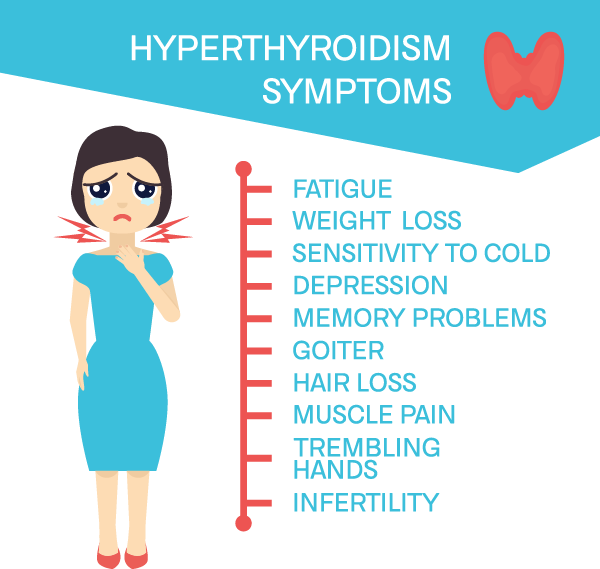
Signs and Symptoms of Hyperthyroidism:
When your thyroid gland is overactive, your body’s processes speed up. This acceleration can bring about:
-
Excessive sweating
-
Heat intolerance. Your thyroid gland regulates your body temperature. When your thyroid gland produces excessive hormones than your body needs, your temperature likely to climbs up. As result, you might find yourself extra sensitive towards heat.
-
Increased bowel movements.
-
Tremor (usually fine shaking). Hyperthyroidism is linked to movement disorders and can even aggravate the tremors associated with the neurodegenerative disorder Parkinson’s disease.
-
Nervousness, agitation, anxiety
-
Rapid heart rate, palpitation, irregular heart rate. Your thyroid hormone directly affects your heart. So, when hyperthyroidism increases your heart rate, you can experience palpitations and abnormal heart rhythm, also known as atrial fibrillation.
-
Weight loss. The thyroid gland regulates metabolism. Hyperthyroidism regulates metabolism at a much faster pace causing weight loss.
-
Fatigue, weakness
-
Decreased concentration
-
Irregular and scant periods (menstruation). High thyroid hormone levels can disrupt your other hormone levels, disrupting your ability to conceive. Prepubescent girls with hyperthyroidism might experience delayed menstruation, while menstruating women may experience decreased menstrual flow (hypomenorrhea) as well as missed periods (amenorrhea).
Causes of Hyperthyroidism:
-
The most common cause (in more than 70% of people) is the overproduction of thyroid hormone by the entire thyroid gland. This condition is also known as Graves’ disease. Grave’s disease is an auto-immune disorder that results in your body creating too much thyroid hormone. Graves’ disease is caused by antibodies in the blood that turn on the thyroid and cause it to grow and secrete too much thyroid hormone. This type of hyperthyroidism tends to run in families and it occurs more often in young women. About 1% of the U.S. population is affected by it.
-
Another type of hyperthyroidism is characterized by one or more nodules or lumps in the thyroid that may gradually grow and increase their activity so that the total output of thyroid hormone into the blood is greater than normal. This condition is known as toxic nodular or multinodular goiter.
-
Inflammation of your thyroid hormone is called thyroiditis. This condition is caused by a problem with the immune system or a viral infection that causes the gland to leak stored thyroid hormone. The same symptoms can also be caused by taking too much thyroid hormone in tablet form. In these last two forms, there is excess thyroid hormone but the thyroid is not overactive.
-
Increased iodine intake. Some foods and medications contain iodine, and too much can over-stimulate your thyroid
How is Hyperthyroidism being diagnosed?
The doctor will ask about symptoms, perform a physical examination, and possibly other laboratory tests. A physical examination usually detects an enlarged thyroid gland and palpitations. The physician will also look for moist, smooth skin and a tremor of your fingers. Your reflexes are likely to be fast, and your eyes may have some abnormalities, bulging of your eyes called Grave’s ophthalmopathy.
The diagnosis of hyperthyroidism will be confirmed by laboratory tests that measure the number of thyroid hormones— thyroxine (T4) and triiodothyronine (T3)—and thyroid-stimulating hormone (TSH) in your blood. A high level of thyroid hormone in the blood plus a low level of TSH is common with an overactive thyroid gland. If blood tests show that your thyroid is overactive, your doctor may want to measure levels of thyrotropin receptor antibodies (TRAbs), which when elevated confirm the diagnosis of Graves disease. Your doctor may also want to obtain a picture of your thyroid (a thyroid scan). The scan will find out if your entire thyroid gland is overactive or whether you have a toxic nodular goiter or thyroiditis (thyroid inflammation).
How can Hyperthyroidism be treated?
-
Antithyroid Medications.
These drugs interfere with the production of thyroid hormones. Methimazole (brand name Tapazole) is the most commonly prescribed hyperthyroidism medication, whereas propylthiouracil (also known as PTU) is preferred during the first trimester of pregnancy. Antithyroid drugs carry a small risk (0.2-0.5% of Graves’ disease patients) of agranulocytosis, which is a rare but serious blood condition that can result in death. Antithyroid drugs cause allergic reactions in about 5% of patients who take them. Common minor reactions are red skin rashes, hives, and occasionally fever and joint pains.
-
Radioactive Iodine Therapy (RAT):
This method damages the cells that make thyroid hormones. Thyroid cells need iodine to make thyroid hormone, they will take up any form of iodine in your bloodstream, whether it is radioactive or not. Radioactive iodine gets into your bloodstream and readily taken by overactive thyroid cells. Radioactive iodine destroys the cells that have taken it up. The result is that the thyroid or thyroid nodules shrink in size, and the level of thyroid hormone in the blood returns to normal.
-
Surgery:
Also known as a thyroidectomy, the surgery to remove the thyroid (either one part of the entire gland) can be an effective treatment for hyperthyroidism. Possible complications include hypocalcemia (low calcium in the blood) and airway obstruction, though both occur in under 5% of surgeries.
-
Beta-blockers:
No matter which of these three methods of treatment are used for your hyperthyroidism, your physician may prescribe a class of drugs known as beta-blockers that block the action of thyroid hormone on your body. Beta-blockers minimize the effects of thyroid hormones on your body, such as to slow down a rapid heart rate and reduce hand tremors.
References
- Felman, A. (2017). What's to know about hyperthyroidism. Retrieved from MedicalNewsToday: https://www.medicalnewstoday.com/articles/9153
- Hyperthyroidism. (n.d.). Retrieved from AMERICAN THYROID ASSOCIATION: https://www.thyroid.org/hyperthyroidism/
- Simone De Leo, S. Y. (2016, March). Hyperthyroidism. Retrieved from NCBI: https://www.ncbi.nlm.nih.gov/pmc/articles/PMC5014602/
- Walfish, B. (2020, September 9). All About Hyperthyroidism. Retrieved from www.endocrineweb.com: https://www.endocrineweb.com/conditions/hyperthyroidism/hyperthyroidism-overview-overactive-thyroid
Find articles related to: Medicine Telehealth Health Hyperthyroidism Overactive Thyroid
More articles about General Health Tips & News
Back to the Health Tips Index